Huel Sold for $1.2B. I Saw Why.
Their email program isn't selling. It's doing something smarter.
|
|
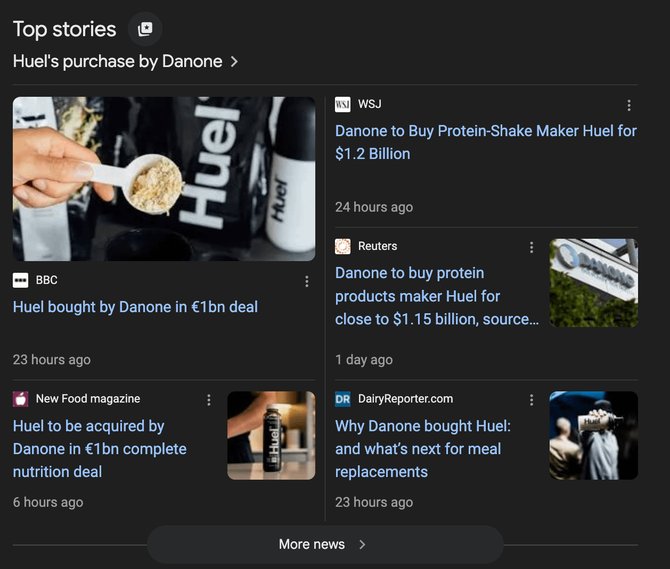
Happy Wednesday! Huel just got acquired by Danone for $1.2 billion. I drink this stuff every single morning, so when the Wall Street Journal notification popped up, I stopped what I was doing and went straight to my inbox.
I've been a Huel subscriber for over a year now. And the first thing I thought wasn't about the price tag or the exit multiple. It was about the emails. Because Huel's email program is one of the reasons I'm still a customer, and I don't think most people realize how deliberate that system is.
That's what made me pull apart their entire email operation. After the acquisition hit on Monday, I sat down and went through 142 of their emails. I audit 10-20 Klaviyo accounts per month, and the gap between what Huel is doing and what I see in most DTC accounts is staggering. Not because the brands I work with are bad. They're just building email programs around a completely different assumption. Most brands treat email as a revenue channel you blast when you need a sales bump. Huel treats it as an identity system that makes you feel like a Huel person before you ever think about churning. Product Placement, Not PromotionLet me show you what I mean. They send a weekly digest. They've sent over 200 editions, every single week for almost four years straight. And every edition has the same subtle thing going on: there's a shaker on the counter, someone mid-sip, the product is ALWAYS in frame. But there's never a shop now button. No discount codes, no urgency countdowns, nothing that feels like a pitch. It's product placement inside owned media. The same way a TV show puts a can of Coke on the table without cutting to a commercial. You see the product being used by someone who looks like you, in a context that feels normal, and it reinforces the habit without asking for anything. I know this works because it worked on me. I'm literally the proof. Their digest kept Huel in my head as something I use, not something I buy. That's a completely different relationship with a brand, and it's the reason I never even considered canceling my subscription. Three Offers, Three Types of CustomerNow here's where it gets really interesting. When Huel wants to convert a subscriber to a recurring subscription, they don't just throw a discount at you. They run three completely different offers and let you self-select into whichever one matches who you are. The first is a straight 20% discount. Standard price incentive for people who are motivated by savings. The second is a welcome kit. Extra gear, a shaker, recipe cards. This is for the person who wants to feel like they're joining something, not just buying powder. The third is a free branded t-shirt. And this is the one that fascinates me as a retention marketer, because a t-shirt isn't an incentive. It's an identity lever. I know this because I'm living it. I drink Huel every day. I own the shirt. And when I put it on walking around Williamsburg, it's not because I got a good deal on protein powder. It's because Huel says something about the kind of person I am. I'm surrounded by founders, engineers, people in tech who think about optimization and forward progress. Huel fits into that world. The t-shirt isn't merch. It's a membership badge for a community I already belong to. When someone picks the t-shirt over the discount, Huel just learned something most brands never figure out. That person isn't price-sensitive. They're identity-driven, and they need a completely different retention path than someone chasing a coupon code. Most brands never get this data because they only test price against price. 10% vs. 15% vs. 20%. They're measuring how cheap someone needs it to be, when they could be learning who their customer actually is. Understanding your customer avatars at that depth, what identity they're buying into, what community they see themselves in, changes everything about how you communicate with them. But almost nobody maps their ICP that deeply. The Numbers Behind the MachineThe numbers back it up. Huel runs a 22% refer-a-friend rate. 60% of those referrals convert. They cut their ad spend from 41% to 35% of revenue while still growing 16% year over year. That's not a company running sales. That's a company that built an identity machine and let it compound. The Playbook Is Right ThereI see it every time I audit a new account. Products people love, subscribers who opted in because they were genuinely interested, and a Klaviyo account that reduces the whole relationship to "here's 15% off, buy now." A welcome flow with one email. No post-purchase education. Huel didn't get acquired for $1.2 billion because their powder tastes amazing (I like it, but let's be honest). They got acquired because they built retention infrastructure that turns customers into believers. The email program is a huge part of that. And the wild thing is, none of what they're doing is technically complicated. Weekly digest, identity-based offers, product placement instead of hard sells. Any brand on Klaviyo could build this. Most just don't because they're too busy chasing the next campaign send. If any of this sounds like your account, I'll tell you exactly where to start.
Or just reply to this email. I read every one. Talk soon. - Raymond |